
Singing in the May: A Folk Song Essay for a Folk Song Playlist
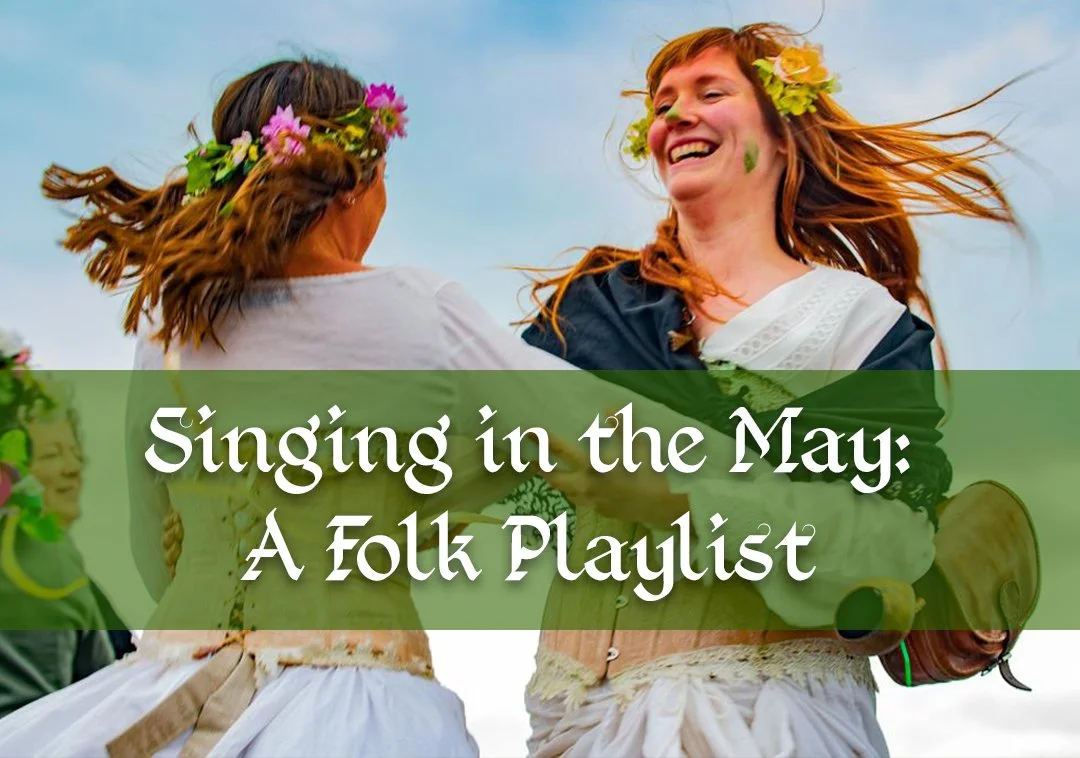
May has come, and I’ve created a brand new May song playlist for you! Singing in the May is an introduction to (mostly) traditional May and spring songs that cavorts its way from the Anglo-Celtic Isles to Eastern Europe and back again. The backbone of this playlist is English folk song, but intertwined you’ll hear songs in Irish Gaelic, Lithuanian and Ukrainian as well. You can click on the link above, or enjoy a folk essay of the playlist below to contextualize some of the dreamy and playful songs you’ll be hearing!
In many parts of Europe, May heralds the arrival of summer: Fresh greens and shoots are growing, the weather is warm enough for outdoor festivities (which also historically meant less oversight by the church), the sun’s arc lasts long across the sky each day, and songs and calls of migratory birds, mating frogs and busy insects can be heard across the fields and forests. A bird whose call announces the spring in many places has been the cuckoo. Filled with lore concerning love, luck, trickery and eroticism, this bird (who spends the winter months in north Africa, arriving back north in the spring) is a favorite to sing about across Europe- and features heavily in our playlist, beginning with our first song Sumer is Icumen In, a 13th century English tune that evokes this bird’s signature call throughout. In England, May ushers in many traditions, including the welcoming of Jack in the Green, and the running of the Obby Oss in Cornwall. The Jack in the Green tradition, which likely dates to the 18th century but is wonderfully animist in nature, features the parading of a figure covered in foliage and flowers through the streets, accompanied by music and song. The origins of the Obby Oss (or “Hobby Horse”) traditions of Cornwall are less clear and much debated, and the song Hal an Tow is often a part of its celebrations, while The May Song also sings of this esoteric creature.
The sharing and displaying of flower garlands has also been a popular May tradition in many parts of Europe, represented in our playlist with two Gaelic tracks and one English track: Thugamar Féin an Samhradh Linn, a garlanding song from Ulster, Amhrán Na Craoibhe a processional chant-like song from County Armagh sung by women who carry the May garland, and The First of May, from Bedfordshire. Presenting May garlands and bushes has often been a way to gift neighbors and family the plants that provide protection during the transitional time into summer. In Ireland, favored plants could vary by region, but rowan, elder, blackthorn and hawthorn were often prime choices. The birch tree, featured in the Birch Song by Jack Durtnall, is a reminder of this tree’s many virtues, including its use against malicious magic during the arrival of summer: On May morning in parts of Herefordshire, England, birch used to be propped against stable doors to protect against witchcraft that could harm the horses within.
Many practices across Europe reflect this need to shield against magical or spiritual forces at this time of year. We often think of May as a time of reaching out and union: the leafing trees reach towards the watery, fecund sky, the blooming flowers seek the kiss of honeybees, many species mate and raise their young. But for all the hope and amorous nature of the season, this could also a period of movement, migration and separation: In pastoral societies, this was the time of year when the cattle or sheep would be brought up into the higher pastures, splitting the community for the warmest season as some performed agriculture while others looked after the flocks. Thus, the shift into summer is a popular moment for the use of protective folk magic. In this playlist you’ll find some versions of Provedu ya rusalochky, a traditional Ukrainian song from the Chernobyl region typically sung in May or early June. This is an example of a rusalka song, a type of song typically used by women and girls to ritually help usher unhappy ancestral spirits out of the household and into cemeteries. A typical verse of this song translates as: “I will lead the rusalky past four pine forests / And I, a young girl, will return alone to my father’s yard.”
Armed with many forms of protection at this time of year, we can still revel in the grand and miraculous gifts of the sun, which is why this playlist features Lithuanian songs about the sun deity/spirit Saulė, such as Kas tar teka par dvarelį and Apėja sauliūte. This former song talks about the sun “Saulala” bringing gifts at dawn. Roughly translated, the words read: “Saulala is the one who is running / What is the one who is running carrying? / She is bringing gifts.” Sung as a sutartinė, a form of polyphony that overlaps the melody to create mesmerizing harmonies, Kas tar teka par dvarelį is traded between three voices, pulling us round and round like the rotations of the sun Herself.
I hope you enjoy this playlist!
