
WNC Pagan Choir Fall Finale 2026 Program
Thank you to the many animate forces, deities and local spirits we celebrate in our songs this evening. Thank you especially to the Native spirits of place, including Tsul 'Kalu/Judaculla and the Yunwi Tsunsdi, who have been a part of these lands since the beginning of time.
We are accompanied this evening by Jay Beck. Jay will be playing a variety of instruments created and carried by many cultures. This evening his instruments include the Djembe and dununs- instruments crafted in Guinea and Mali respectively- a Doumbek crafted in Egypt, India ghungroo bells and elephant bells, and rattls from Peru. We will also be hearing the voice of the shruti box this evening, a harmonium instrument with origins in India. We are grateful to the many musicians and craftspeople and cultures who have kept the voices of these instrument beings alive and cared for.
Gratitude to the Land of Sky UCC for being such a wonderful home to us this season!
1) Sun Going Down, by Heartwood Trio
Created by the Heartwood Trio: Heidi Ann Wilson, Sarina Partridge and Willy Clemetson. Created Oct, 2023. Rabbit Island, Keweenaw- Upper Peninsula Michigan. Some additional harmonies by Saro Lynch-Thomason.
2) In Your Element, by Ashley Johnson
3) Brigantia
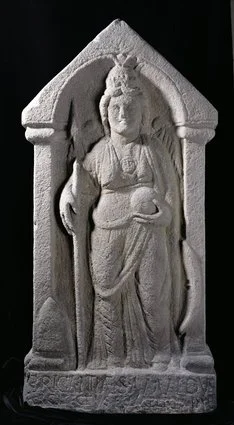
By Saro Lynch-Thomason, Brigantia, Manchán Magan, A. Ozinskas, and probably many other unnamed benevolent guardian spirits, September 2026
Image: A Romano-Celtic depiction of Brigantia, who was beloved by the Brigantes, Celtic-Britonnic peoples of Northern England.
4) Scots-Gaelic Chants
Created in collaboration by Saro Lynch-Thomason and Sìne McKenna
Gaelic chant for grieving: 'S trom mo chrìdhe trom, 'S trom mo chrìdhe trom (“strowm mo chree-uh trowm”)
Translation: Heavy is my heart, heavy
This phrase comes from a song known to Sìne as the “Sleep Song,” or “Caìdil ù ò”
Gaelic chant for blessing: Gu robh gach gealach agus grian leat o, Gu robh gach gealach agus grian leat o (“goo raw gach gyowloch aguhs gree-an let o”)
Translation: May every moon and the sun be with thee
This phrase is from the traditional Hebridean song Chraobh nan Ubhal, sometimes used as a waulking song
5) Bundo Matir
By Saro Lynch-Thomason, June 2023. In the partially reconstructed proto-Celtic language. Many thanks to the Street Creature Puppet Collective for the use of their puppets!
Part 1: Bundo Matir, Kelyo Matir, Sordo Matir, Witsu Matir
Part 2: Molyeyo, molyeyo, molyeyo, molyeyo
Parts 3 & 4: Bundo, kelyo, sordo, witsu
Translation:
Part 1: Earth/dirt Mother, Death Mother, Shining Mother, Wisdom Mother
Part 2: Praise, praise, praise, praise
Part 3: Earth, death, shining, wisdom
Intermission
6) Dijuta Kalnali
A traditional Lithunian sutartinė. This ancient form of polyphony is said to have been taught to the Lithuanian people by cranes and other waterfowl. This song was ritually sung at a hill in northern Lithuania called Dijokalnis, possibly as part of coming-of-age and marriage ceremonies. Over time, the Lithuanian neo-pagan tradition of Romuva has added new verses. This song is now used to “wake up” the sacred elements and deities when beginning ritual.
Dijūta kalnali… / Dijūta žemelė… / Dijūta saulāla…/ Dijūta ugnelė…
Translation: Dijūta hill… / Dijūta, dear earth…/ Dijūta dear sun…/ Dijūta, little fire…
7) The Earth Says to the Earth, by Ali Burns
This song by Scottish composer Ali Burns was inspired by an epitaph on a tombstone found in the Scottish Borders, which read:
“The earth goeth on the earth
Glistening like gold The earth goeth to the earth
Sooner than it would
The earth builds on the earth
Castles and towers The earth says to the earth
All shall be ours”
8) Oy Davayte
A harvest song from the Zhytomyr reagion of Ukraine. Arrangement by Saro Lynch-Thomason. Taught to Saro by Nadia Tarnawsky.
This is a type of harvest song known as a “zazhynky,” meaning “after the harvest.” A zazhynky would be sung towards the end of the harvest day as a kind of “pick-me-up” for those cutting and stacking the grains, and could often include playful verses poking fun at various workers in the field. The first of last sheaf from a field- called the “Didukh” (“grandfather”)- had important ancestral significance, and was kept at ancestral altars in the home, and put underneath the tablecloth at Christmas dinner.
9) Sunne’s Still
Words by Trey Moonwood. Melody adapted by Will Rowan. Arrangement by Saro Lynch-Thomason
This song, centered in Norse mythology, is a petition for the sun to return at the winter solstice. The sun is referred to in the song by the old English word “Sunne,” though in Norse mythology she would have been known as “Sol” or “Sunna.” The lyrics suggest that if the sun does not return, Ragnarok, a time of cataclysmic destruction, might begin. Portions of the lyrics refer to the Poetic Edda, an important source of Norse mythology. This song’s chorus commands us to “stop the wheel, the spindle’s whorl”- that is, to not use the spinning wheel, referencing an old Scandinavian belief that it is bad luck to spin objects at Yule/Christmas time. This tradition may have been a protective one towards the sun- ensuring that our spinning would not send her off course an unable to bring back the warm months.
10) Ritual: Gaelic Chants for Grieving and Blessing (see above)
11) Ancestors Old
Song by Nickomo Clarke. Portions of dance by Rasullah Clarke. Harmonies and portions of choreography by Saro Lynch-Thomason.
Is beannaithe thú, oh Cailleach / Is beannaithe thú, oh Cailleach
Is beannaithe thú, oh Cailleach / Is beannaithe thú (2x)
Samhain, Samhain / Samhain, Samhain
Ancestors old, ancestors new / Join us in our dance upon this day
Beyond the old, before the new / In between the worlds we find our way
Samhain, Samhain / Samhain, Samhain
Translation of Gaeilge:
Is beannaithe thú, oh Cailleach: “You are blessed, oh Cailleach”
Samhain: “Summer’s end”