By Saro Lynch-Thomason. Published January 18, 2021.
It’s hard time cotton mill girls
Hard times everywhere!
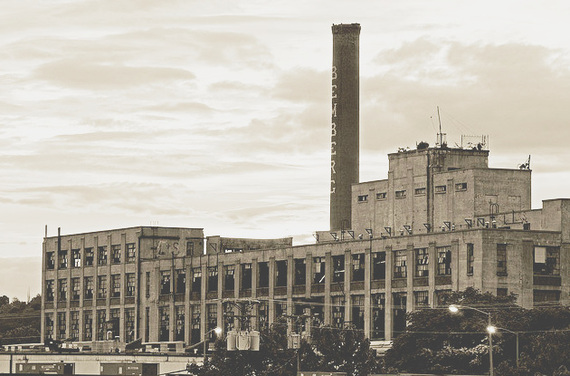
When I was young and the summertime humidity became too much to bear in Nashville, my parents would put my sister and me in the car, and we’d head towards our family’s cabin in the Blue Ridge of East Tennessee. Our route always took us through the small town of Elizabethton, in mountainous Carter County. In all those years, I never noticed an enormous, deteriorating building set back several hundred yards from the main road. Only as an adult in graduate school in nearby Johnson City did I seek out that building, so easy to miss. Rising up several stories, it’s washed out brick exterior is mottled with large broken windows that look like rows of shattered teeth. This building, which watches Elizabethton’s busy Route 91 like a doleful ghost, was at one time the Bemberg Plant, a German-owned rayon factory that employed thousands of men and women. It was also the site of a strike started by women workers in 1929- a strike that had consequences for textile workers across the Southeast. While there are no songs I know about this strike, we can explore much about its culture and history through a song that emerged in the same period: “Cotton Mill Girls.”
“Cotton Mill Girls” as I know and teach it, has a lot to say about women’s conditions in textile mills and the ways in which women negotiated power at their places of work in the early twentieth century. I learned my version of the song from folk musician Stephen Griffith, who in turn created his version from four different sources, including a version by musician Hedy West and an older version recorded in 1930 by a band called the Lee Brothers. The Lee Brothers, who recorded “Cotton Mill Blues” in Atlanta in 1930, appear to be the originators of the song. The Lee Brothers’ version focuses generally on the hard conditions of textile mill work, but by the time Hedy West was singing the song in the 1960s, someone had clearly transformed its theme to focus on women’s labor. Amongst other lyric changes, the Lee Brothers’ refrain of, “It’s hard times in this old mill, it’s hard times in here,” was sung by West as, “It’s hard times cotton mill girls, hard times everywhere.” Griffith’s excellent compilation of several versions of the song creates a cohesive summarization of the experiences of tens of thousands of mill women in the Southeast in the early twentieth century. Looking at the struggles and triumphs of the mill women of Elizabethton, the verses of “Cotton Mill Girls” can take a more solid form in our mind’s eye.
In 1915, we heard it said
Move to cotton country and you’ll get ahead.
By the early twentieth century, cotton mills dotted the landscape of the Southeast. Although the North had previously been the center of the U.S.’ textile industry, investors had begun to migrate textile manufacturing south after the Civil War, seeking low wage, non-union labor, access to cheap water power, and a greater proximity to the source material of cotton. The industry grew and thrived with the advent of World War I, raising wages and compelling many men and women to migrate to factory towns and start work in the mills. Thus, 1915 was a fortuitous time to seek work in the textile industry. By the end of the second decade of the twentieth century, more Southerners worked in textile mills than most other occupations.
Look at that train going round the curve
She’s loaded down with cotton mill girls.
During this period, European textile producers also began to look to the American South as a promising frontier for cheap labor and land. In 1926, the J.P. Bemberg Company of Germany opened a rayon yarn factory in Elizabethton, and three years later, Vereinigte Glanzstoff Fabriken opened a jointly-managed branch nearby. The plants offered many jobs to women, who jumped at the opportunity to do what was then called “public work”- wage earning labor performed outside the home. Rural families across the mountain south had been struggling to survive in an ailing agricultural economy for decades, and Carter County was no exception. Many young women left the struggling farms that were their homes and sought work at the plants to be able to make money for their families. Other young women wanted the thrill of receiving their own paychecks, whether that paycheck was to support their families or to help them live independently. Work at the plants also helped some women specifically escape farm life. Bessie Edens, who started working at the Elizabethton mills at the age of 17, recalled that a daughter’s life on the farm was drudgery, saying, “The girls were supposed to do housework and work in the fields. They were supposed to be slaves.” Like Bessie, the women who sought work at these plants were young indeed. Most were between the ages of 16 and 21, but some were as young as 12.
Us girls we work 10 hours a day
For fourteen cents of measly pay
By the late 1920s, women made up a powerful contingent of the mills’ workforce. According to company sources, they held 30 percent of the jobs at Bemberg and 44 percent at Glanzstoff. While many of the women were proud to work at the plants, they also knew they were being short changed. Their long, grueling shifts always resulted in low wages. Flossie Cole, a young woman from a farming family, worked fifty-six hours her first week at Bemberg and took home $8.16. These paychecks were low even for the southern textile industry, and to top it all off, the women were being paid less than the men. Bessie Edens heard directly from a German mill owner or manager that representatives from Elizabethton had courted the German companies by saying, “women wasn’t used to working, and they’d work for almost nothing.”
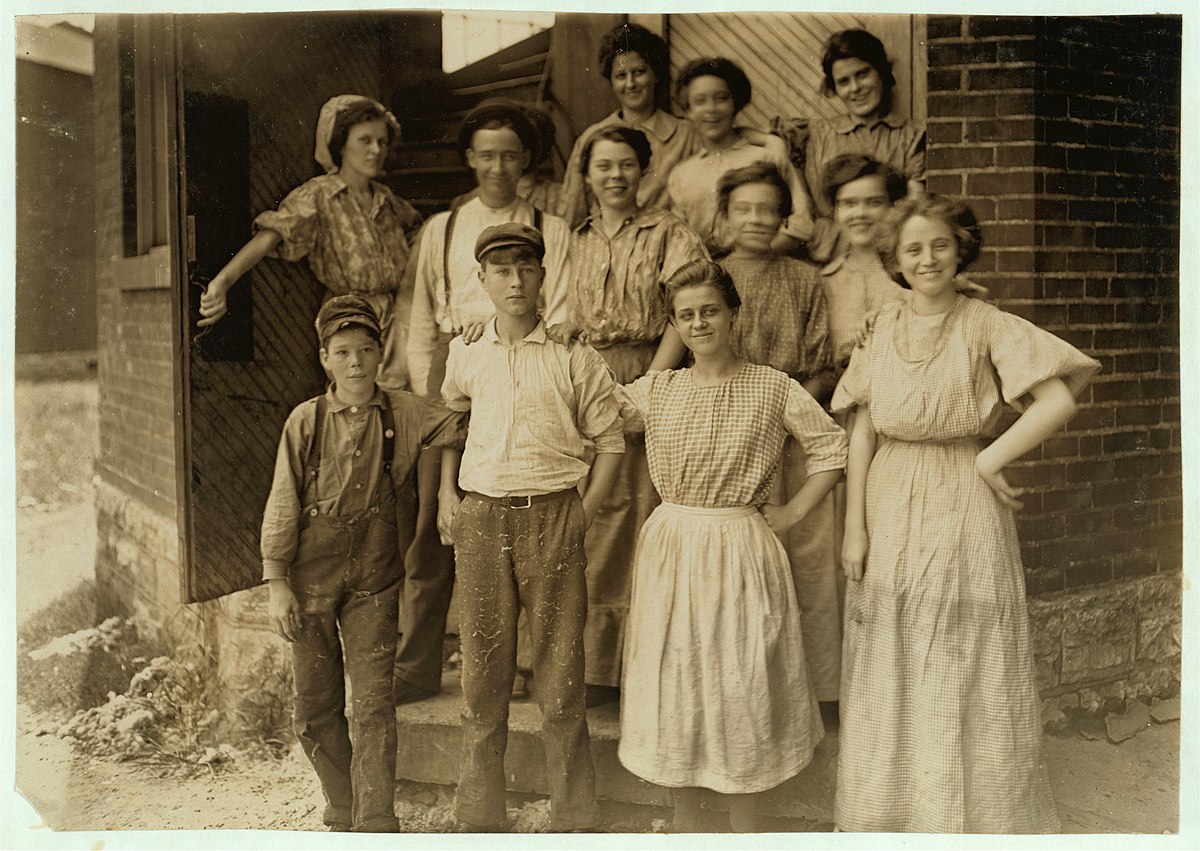
Women workers were also getting tired of strict rules in the mills designed to maximize efficiency.
I went downstairs to get a drink of water
Along comes the boss, says, “I’ll dock you a quarter.”
Flossie Cole recalled, “If we went to the bathroom, they’d follow us, ‘fraid we’d stay a minute too long.” If the women stayed longer in the bathroom than the companies deemed appropriate, their pay was docked, and one too many trips could cost them their jobs.
In early 1929, the long hours, poor pay, and dehumanizing rules suffered by the women of the mills were fomenting anger and resentment. The companies’ assumption that the women would “work for almost nothing” was about to be proven wrong.
“You can dock me a quarter, dock me a dime,
But I’ll go to the office and I’ll get my time.”
On March 12, 1929 a worker named Margaret Bowen asked for a raise for herself and her inspection department at the Glanzstoff Mill. Margaret had been talking to the management about a raise for weeks, and this time, not only was she refused, but the foreman suggested she open a bank account, implying that she didn’t know how to save money. Bowen’s department decided to walk out. By the end of lunch that day, between three hundred and five hundred women had walked out of the plant.
The next day, on March 13, the women returned to the Glanzstoff Mill and led the rest of the workforce out on strike. Five days later Bemberg workers came out as well. Things moved quickly. The strikers secured a charter from the AFL’s United Textile Workers union (UTW) and began picketing the plants. Meanwhile, mill and town management panicked, and injunctions were created forbidding all demonstrations against the companies- injunctions the strikers ignored. Next, town officials joined plant managers in convincing the governor to send in the National Guard, who set up machine gun nests to guard the roads leading to the plants.
The conflict lasted weeks, then months. And throughout, the women- most of them teenagers- were creative and fierce in their efforts to maintain the strike. They performed sit-down blockades on roads to prevent replacement workers from being bussed in. They teased and even attacked guards, and shamed strikebreakers. They also conducted silent marches through Elizabethton, parading down the Bemberg Highway “…draped in the American flag and carrying the colors,” thus forcing the guardsmen to present arms each time they passed.
The strikes lasted until May 23, when an agreement was reached that required Bemberg and Glanzstoff to rehire all former employees and prohibited them from discriminating against union members. However, no other victories were won. The United Textile Workers Union, who negotiated the agreement, was lacking in resources and commitment to the strike, and reduced the strikers’ demands significantly. The UTW agreed to a settlement that failed to address working conditions, hours, wages or union recognition.
When work resumed at the plants, it swiftly became clear that Bemberg and Glanzstoff did not intend to uphold the requirements of the agreement. The management fired and blacklisted hundreds of workers and new company-run unions were formed to encourage employee loyalty. Many of the women who were fired went back to farming or found domestic work, and some continued to be labor organizers. Bessie Edens recalled later, “I knew I wasn’t going to get to go back, and I didn’t care…I wrote them a letter and told them I didn’t care whether they took me back or not. I didn’t! If I’d starved I wouldn’t of cared, because I knew what I was a’doing when I helped to pull it. And I’ve never regretted it in any way…. And it did help the people, and it’s helped the town and the country.”
The legacy of these strikes can be weighed from different angles. Ultimately, the strikers did not get what they demanded, and their defeat cost them their jobs and economic stability. But the strike also had repercussions across the Southeast. Soon after the Elizabethton strike began, a wave of textile mill strikes surged across North and South Carolina, triggered, scholars theorize, by what was happening in Elizabethton. Many of these new strikes were also started and maintained by women.
While the lyrics of “Cotton Mill Girls” expresses the sentiments of many women in the textile industry, one verse may not have rung true for many of the women working for Bemberg and Glanzstoff:
Working in a cotton mill ain’t no harm
But I’d heap rather be down on the farm.
While many of the women who worked in the plants no doubt deeply ached for open air and the scent of soil, once the strikes were over, many had no intention of returning to farm life. The strikes gave the women of Elizabethton opportunities to exercise their autonomy in ways they never had before. They learned to be outspoken. They learned to be rude. They dressed up and looked their best while blockading roadways and laughing in the faces of armed men. After such experiences, going back to their former lives would have seemed impossible. These women who had occupied public space in daring and unexpected ways would never forget their experiments in self-determination, and their defiant choices would change the social and political landscapes of their daughters and granddaughters for decades to come.
Sources:
Edens, Bessie. Interview by Mary Frederickson, Elizabethton, Tenn., Aug. 14, 1975.
Griffith, Stephen. “Cotton Mill Girls.” Folk Song Index.com. http://www.stephengriffith.com/folksongindex/cotton-mill-girls/
Grindstaff, Flossie Cole. Interview by Jacquelyn Hall. Elizabethton, Tenn., July 11, 1981.
Hall, Jacquelyn Dowd. “Disorderly Women: Gender and Labor Militancy in the Appalachian South.” The Journal of American History, 73, no. 2 (Sep., 1986): 354-382.
Shirley, Neal and Saralee Stafford. “Wild Hearts in the Southern Mills: Women in the Strike Wave Against the Textile Industry, 1929-1930” in Dixie Be Damned: 300 Years of Insurrection in the American South, 147-157. Oakland: AK Press, 2015).
Tedesco, Marie. “Elizabethton Rayon Plant Strikes, 1929.” Tennessee Historical Society, March 1, 2018. https://tennesseeencyclopedia.net/entries/elizabethton-rayon-plants-strikes-1929/